Let's face it, the universe is messy. It is nonlinear, turbulent, and chaotic. It is dynamic. It spends its time in transient behavior on its way to somewhere else, not in mathematically neat equilibria. It self-organizes and evolves. It creates diversity, not uniformity. That's what makes the world interesting, that's what makes it beautiful, and that's what makes it work.”
― Donella H. Meadows, Thinking in Systems: A Primer
What is systems thinking?
System dynamics is the modelling of conditional, imprecise projections of dynamic behaviour
Education problems are often shaped by feedback loops, but these are easy to miss. We tend to explain academic success in simple, linear terms, as if factors such as motivation, teaching quality, home environment, and school resources act independently and have immediate effects. Figure 1 illustrates this limited way of thinking.
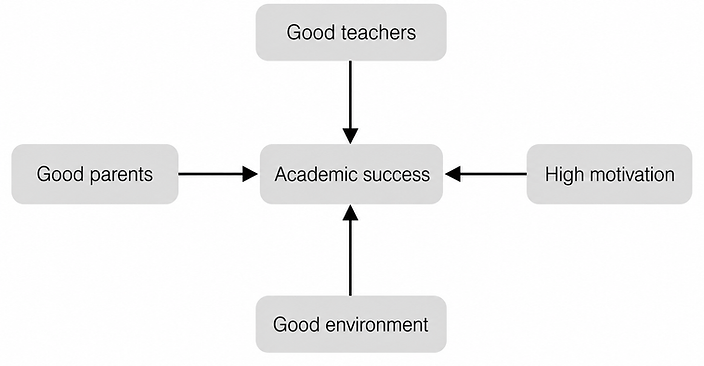
Figure 1: Traditional boxed thinking does not take feedback into consideration.
Figure 2 shows a more realistic view of the system. Academic success is shaped by factors that interact over time, often with delays and nonlinear effects. A change in one part of the system can strengthen, weaken, or redirect change elsewhere.
For example, good teaching can improve academic success, while visible learner progress can also motivate teachers to sustain or improve their practice. Parents may support academic success directly through homework support, and indirectly by contributing to a stable home environment. That home environment can then affect how much support parents are able to provide.
In this view, education outcomes are not produced by isolated factors. They emerge from the interaction between learners, teachers, families, schools, and wider conditions over time.

Figure 2: Systems thinking understands the dynamic feedback between elements.
Feedback is the part of a system in which some portion (or all) of the system's output is used as input for future operations. Feedback loops can be either negative or positive. Negative feedback loops are self-regulating and useful for and maintaining an optimal state within specific boundaries. Negative feedback loops are known for being stable, but not especially accurate.
In contrast, positive feedback loops simply repeat actions that have been effective in the past. The intention of a positive feedback loop is to amplify a desired variable and naturally move the system away from its starting state to a desired state. Problems can occur, however, when the positive feedback loop grows exponentially without any checks or balances.

Graduates
Teachers
needed
Teachers
hired
Demand for
teachers
Gap
Teachers
hired
Time
Figure 3: Negative feedback exhibits goal seeking behaviour.

Academic performance
Learner motivation
Academic performance
Time
Figure 4: Positive feedback propagates behaviour to exhibit growth.
The combination of positive and negative loops enable us to analyse the observed variable in any system. Complex systems behave in ways entirely different from our expectations derived from experience with simple systems. Because intuition is based on simple systems, people are misled when making decisions about complex systems. System dynamics simulation modelling is the key to making the correct decisions.
Try a systems thinking game
Systems thinking is easier to understand once you have to make decisions over time. In this short game, you manage a school system by choosing interventions under limited resources. Some actions work quickly, while others take time to show results. The aim is to see why school improvement usually requires early, sustained and coordinated action, rather than a single quick fix.
